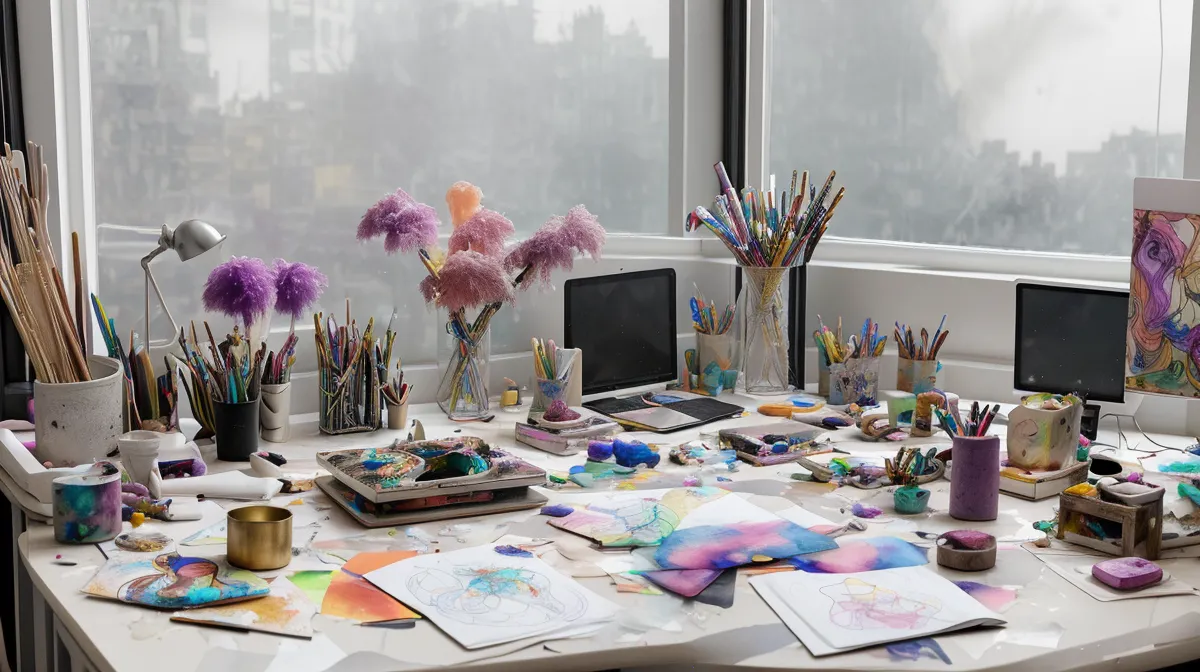
I woke up on a gray Portland morning last week with the phantom sensation of neon violet pigment still wet on my fingertips. It was thick, electric, and vibrating—a color I’ve never quite managed to mix in the physical world. I reached for my sketchbook, but the pages were stubbornly white. The color only existed in the place I’d just left.
Since my spiritual awakening two years ago, I’ve described it as the volume on everything being turned up. But by mid-November of last year, during a particularly brutal freelance drought, that volume felt like static. I wasn’t just blocked; I was walled off. It felt like there was a heavy curtain between my waking mind and the wild, subconscious imagery that usually fuels my work. I realized I was spending a third of my life in a studio I wasn’t actually using: my dreams.
The MILD Technique: Treating Sleep Like a Studio
I started looking into lucid dreaming not as a way to fly or have superpowers, but as a way to go to work. I’m not a sleep scientist or a doctor—just an illustrator who got really tired of staring at a blank screen. I stumbled upon the Mnemonic Induction of Lucid Dreams (MILD) technique, which was developed by Stephen LaBerge at Stanford. It’s surprisingly practical, which is exactly what I needed when my brain felt like mush.

The goal of MILD is to set an intention while you’re falling asleep. You repeat a phrase—mine was 'The next time I’m dreaming, I will remember I’m dreaming'—while visualizing yourself becoming lucid. In late February, during a slow month for commissions, I started treating my sleep architecture like a project timeline. I learned that our sleep isn't just one long block. We move through an average REM cycle duration of about 90 minutes. That first REM stage is usually short, maybe only 10 minutes, but as the night goes on, those periods get longer. By the time you’ve had 4 to 6 dream periods per night, you’ve spent a lot of time in a world where the laws of physics (and color theory) don't apply.
I need to be honest about something: it didn’t work immediately. For the first few weeks, I just had really vivid dreams about my taxes. But after about six weeks of consistent practice, something shifted. I wasn't just watching the movie; I was standing on the set.
The Reality Check: When the Map Becomes the Palm
The turning point happened late one night—or early one morning, time is weird in there. I had been practicing 'reality testing' during the day. This involves asking yourself if you’re dreaming while you’re awake, usually by looking at a clock or your hands. The prefrontal cortex is less active when we sleep, which is why your brain is terrible at rendering consistent text or clock faces in dreams.
In the dream, I was standing in a gallery. I looked down at my own palm to perform a check. Instead of skin and lines, my hand transformed into a topographical map of a city I’d never visited. The streets were glowing gold. I felt that sudden, electric jolt in the chest—the one you get when you realize you’re dreaming and have to stay calm to avoid waking up immediately. It’s a delicate balance. If you get too excited, the dream collapses. You have to breathe through it.
I stood there and watched the map on my hand pulse. It wasn't just a design; it was a layout for a brand identity project I’d been struggling with for weeks. I realized then that common third eye opening symptoms for creatives often manifest as this kind of heightened visual processing, where the boundaries between 'thought' and 'sight' just sort of melt away.
The Performance Trap: Why You Can’t Force the Muse
Here is the thing: there is a lot of advice out there about 'hacking' your brain for productivity. But focusing on lucid dreaming specifically to force creative output often creates this weird performance anxiety. If I went to bed demanding a logo design from my subconscious, I’d wake up exhausted and empty-handed. Performance anxiety kills the very subconscious fluidity you need.
I had to learn to be a witness rather than a director. When I stopped trying to 'use' the dreams, the inspiration came more naturally. I’d notice a specific, static-like hum in my ears right before a dream would stabilize and the colors would sharpen into focus. It’s a sensory cue that the studio door is open. If you’re struggling with this, you might find that why I use theta wave meditation helps bridge that gap between being wide awake and that deep, creative dream state.

Integrating the Dream-Scapes
One rainy Tuesday morning recently, I sat down to finish a client deck. I wasn't trying to copy what I saw in my dreams—that never works, it’s like trying to draw a cloud from memory. Instead, I was trying to capture the feeling of that glowing topographical map. The way the light sat behind the 'streets.' The specific vibration of that neon violet.
Lucidity isn't about controlling your imagination; it’s about being a better witness to it. It’s about showing up to the 90-minute cycles and seeing what your brain has been building while you were 'away.' If you have underlying sleep issues or chronic insomnia, please talk to a professional before messing with your sleep architecture. I’m just an artist, and I’ve found that my best work happens when I let the subconscious lead the way.
It’s been about eight months since I started this experiment, and while I don’t go lucid every night, I’ve stopped fearing the blank page. I know that even if I’m stuck during the day, the studio is always open at night. I just have to remember to look at my hands.